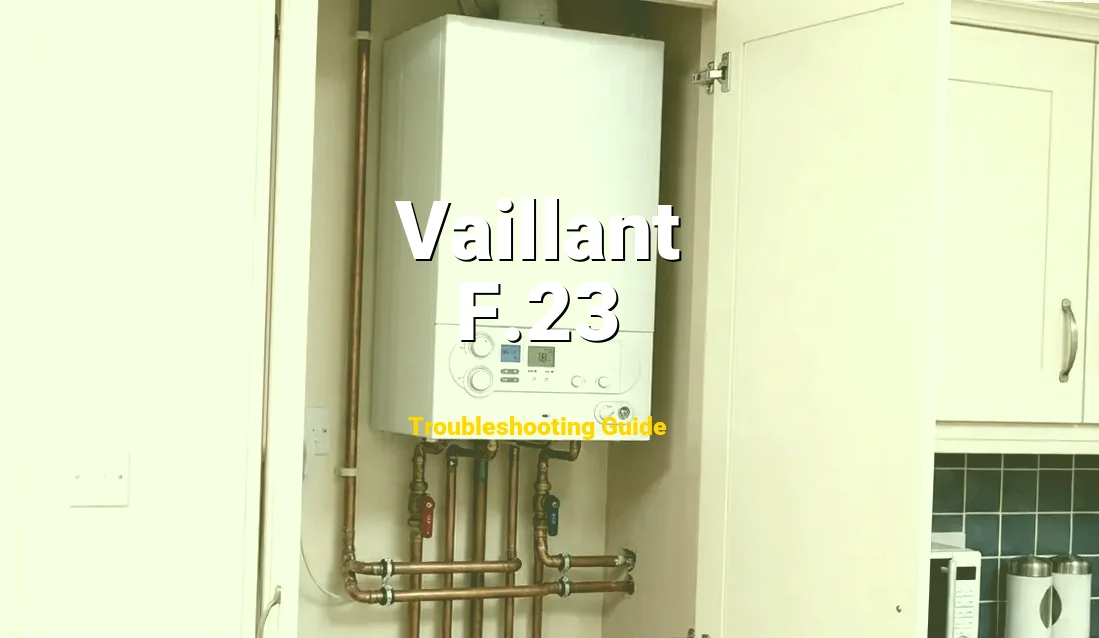
Definition: The Vaillant Error F.23 denotes a “Water Shortage” fault specifically triggered when the temperature differential (Delta-T) between the flow and return NTC thermistors exceeds a safety threshold (usually 35K). Essentially, the boiler detects that heat is being generated but not transported away from the heat exchanger efficiently enough.
🛠️ Safety First: Read Before Repairing
For your safety and to avoid voiding the warranty, please check the official docs.
As a homeowner or technician, you will likely notice your central heating failing to ignite or your hot water running cold after a few seconds of operation. You might also hear “kettling” or banging noises—a sign of localized boiling within the unit. While a lockout can be frustrating, rest assured that F.23 is a protective measure designed to prevent catastrophic damage to the primary heat exchanger. With a systematic approach to diagnostics, we can identify whether the culprit is a simple air lock, a failing pump, or a sensor drift.
Symptoms of Vaillant Error F.23
Before the digital display locks out with the F.23 code, the system often exhibits several mechanical and thermal red flags. Recognizing these can help distinguish between a sensor fault and a genuine circulation issue.
- LCD Fault Display: The boiler will cease operation and the “F.23” code will flash prominently on the interface. The status LED may turn red or flash.
- Rapid Temperature Rise: If you observe the live temperature feed (d.40 in the diagnostic menu), you will see the flow temperature skyrocket within seconds of ignition while the return pipe remains stone cold.
- Audible “Kettling”: You may hear whistling or banging noises. This is caused by water turning to steam inside the heat exchanger because it isn’t moving fast enough to dissipate the burner’s energy.
- Short Cycling: The boiler may fire for 10-20 seconds, shut down briefly, and then try again before eventually giving up and throwing the permanent F.23 lockout.
- Cold Radiators: Even if the boiler thinks it is heating, the heat never reaches the emitters in the house due to the lack of effective circulation.
Troubleshooting & Replacement Instructions
Troubleshooting & Replacement Instructions
Follow these steps in order. Safety Warning: If you are not a qualified gas engineer, do not touch any gas-carrying components. Electrical testing should be performed with the power off unless live testing is required for voltage checks.
- Check System Pressure and Bleed Radiators:
Start with the basics. Ensure your pressure gauge is between 1.0 and 1.5 bar. If it is low, the pump may cavitate. Use your radiator bleed key to vent all air from every radiator in the house, starting from the ground floor and moving up. If a significant amount of air escapes, repressurize the boiler and attempt a reset. Many F.23 errors are resolved here.
- De-air the Pump:
Switch off the power. Remove the front casing by unscrewing the bottom Phillips screws and lifting the panel. Locate the circulation pump. There is usually a large silver screw in the center of the pump head. Place a cloth underneath, and slowly turn this screw counter-clockwise. A small amount of water and air may hiss out. This also allows you to check if the pump shaft is stuck; you can insert a small flat-head screwdriver to manually rotate the impeller to free it up.
- Electronic Pump Testing:
Using your multimeter set to AC Volts, check the power feed to the pump while the boiler is demanding heat. If the PCB is sending 230V but the pump isn’t spinning or humming, the pump or its capacitor has failed. Safety Warning: High voltage is present during this test; ensure your probes are secure and you are not touching any metal chassis parts.
- Testing the NTC Thermistors:
If the pump is running well but the error persists, test the resistance of the Flow and Return sensors. Disconnect the wiring harness from the sensors. At 20°C, a standard Vaillant NTC should read approximately 12k to 15k Ohms. If one sensor reads 2k Ohms (indicating high heat) while the pipe is cold, the sensor is faulty and must be replaced. Use a Phillips head to remove the retaining clip and swap the sensor.
- Verify the Bypass Valve:
If your system has an automatic bypass valve, it may be stuck open or closed. If stuck closed and your TRVs (Thermostatic Radiator Valves) are all shut, the water has nowhere to go, causing an F.23. Ensure at least one radiator (usually the one in the room with the wall thermostat) is fully open without a TRV.
Technical Repair Specifications
| Difficulty Level: | Intermediate to Advanced |
| Estimated Time: | 45 — 90 Minutes |
| Tools Required: | Digital Multimeter, Radiator Bleed Key, Phillips/Torx Screwdriver Set, Adjustable Spanner |
| Estimated Part Cost: | £0 (Bleeding) — £220 (Circulation Pump) |
Why is my Vaillant showing Error F.23?
Why is my Vaillant showing Error F.23?
The F.23 error is a “logic-based” fault. The PCB (Printed Circuit Board) compares the resistance values of two NTC (Negative Temperature Coefficient) sensors. If the gap between them is too wide, the logic assumes water isn’t flowing. Here are the primary drivers of this failure:
1. Circulation Pump Failure or Seizure: The pump is the heart of the system. Over time, internal bearings can wear out, or the capacitor can fail, leaving the motor unable to generate enough torque to move the water. If the pump isn’t spinning, the water sitting in the heat exchanger overheats instantly, while the return water remains at room temperature, creating the massive Delta-T that triggers F.23.
2. Severe Air Locks: Air is a poor conductor of heat and an excellent inhibitor of flow. If a large pocket of air is trapped within the pump housing or the primary heat exchanger, it creates a physical barrier. This “air bind” stops the water cycle entirely. This is common after a system drain-down or if the automatic air vent (AAV) on the pump is capped or blocked.
3. NTC Thermistor Calibration Drift: Sometimes the water is moving fine, but the sensors are lying. NTC thermistors work by changing resistance based on temperature. Due to thermal fatigue or moisture ingress, a sensor’s resistance curve can shift. If the return sensor reports 20°C when the water is actually 50°C, the PCB sees a false “shortage” and locks out.
4. System Contamination (Sludge/Magnetite): In older systems without a magnetic filter, black iron oxide (sludge) can accumulate. This sludge can partially block the narrow waterways of the plate heat exchanger or the main heat exchanger, drastically reducing flow velocity and causing the temperature to spike at the flow sensor.
How to Prevent Error F.23
Prevention is significantly cheaper than a mid-winter emergency repair. To ensure your Vaillant boiler maintains a healthy Delta-T, follow these engineering best practices:
Install a High-Quality Magnetic Filter:
The primary cause of pump failure and heat exchanger blockages is magnetite. Installing a filter (like the Vaillant ecoLEVEL or Adey MagnaClean) captures these metallic particles before they can settle in the boiler’s delicate internals. This keeps flow rates high and sensors clean.
Annual System Chemical Treatment:
Corrosion inhibitor should be checked annually. Over time, the chemical concentration in your heating water thins out, leading to internal rusting. A Senior Engineer will check the “TDS” (Total Dissolved Solids) and top up the inhibitor to prevent the sludge that leads to F.23.
Powerflushing:
If your boiler has a history of F.23 errors and the water looks black or murky, a professional powerflush is recommended. This uses high-velocity, low-pressure pumping to clear the “sludge” from the radiators and pipework, restoring the original flow dynamics the boiler was designed for.
Frequently Asked Questions
Q: Can I reset the F.23 error myself?
A: Yes, you can press the “Flame” or “Reset” button on the fascia. However, if the underlying cause (like a seized pump or air lock) isn’t fixed, the error will reappear within seconds. Repeatedly resetting the boiler without fixing the flow issue can lead to overheating and damage to the heat exchanger seals.
Q: Is the F.23 error dangerous?
A: While it involves high temperatures, it is not inherently “dangerous” in terms of gas leaks. The boiler’s software is designed to “fail-safe.” The F.23 lockout is specifically there to stop the burner before the heat becomes high enough to melt components or cause an explosion. It is a safety feature working as intended.
Q: How do I know if it’s the pump or the sensors?
A: A simple touch test (carefully!) is often enough. If the pump is extremely hot to the touch but the pipes leading away from the boiler are cold, the pump is likely seized. If the pipes are hot and the pump is running, but the boiler still shows F.23, it is more likely a sensor drift or a blockage in the return path.