| Category | Specification |
|---|---|
| Difficulty Level | Intermediate to Advanced (Requires handling gas/electrical) |
| Estimated Time | 45 – 90 Minutes |
| Required Tools | Phillips Head Screwdriver, Multimeter, Fine Sandpaper (or Steel Wool), Gas Manometer (Optional) |
| Estimated Cost | $0 (Cleaning) to $250 (Part Replacement) |
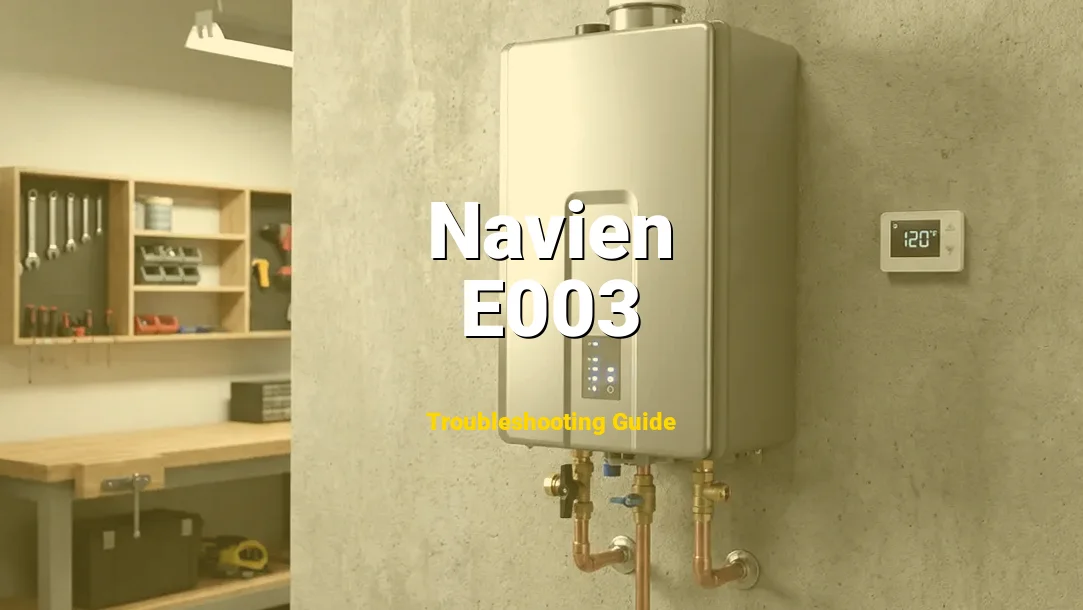
The Navien Error E003 code indicates an **Ignition Failure**. Specifically, it means the unit’s control board attempted to light the burner several times but failed to detect a sustained flame. This is a critical lockout error designed to prevent the dangerous buildup of unburned gas within the combustion chamber.
If you are seeing the E003 code, you are likely experiencing a total loss of hot water, often accompanied by a repeated clicking sound as the igniter attempts to spark, followed by the unit shutting down. While this is a serious technical fault, it is a common issue that can typically be resolved through systematic cleaning, gas supply verification, or component replacement.
The Complete Solution
The Complete Solution: Step-by-Step Fix
WARNING: Before proceeding, you must turn off the electrical power to the unit at the circuit breaker or unplug it. Close the gas shut-off valve leading to the unit. Failure to follow these safety protocols can result in electrocution or gas explosion.
📖 Warning: Check Manual First
Don’t guess the wiring. Get the official PDF to see the exact schematics.
- Verify Gas Supply:
Start with the simplest solution. Ensure the gas lever on the pipe leading to the Navien is turned parallel to the pipe (Open position). Check other gas appliances in your home (like a stove) to ensure the main house supply is active. If you have recently had a new gas appliance installed, your gas line may be undersized, causing a pressure drop that prevents the Navien from igniting. - Access the Internal Components:
Using a Phillips head screwdriver, remove the four screws holding the front cover of the Navien unit in place. Carefully lift the panel off and set it aside. You will now see the sealed combustion chamber, the fan, and the circuit board. SAFETY CHECK: Ensure no wires are frayed or touching metal surfaces. - Inspect and Clean the Flame Rod and Igniter:
Locate the combustion chamber (the large metal box at the top). On the front or side, you will see two or three wires leading to ceramic probes inserted into the chamber. Remove the screws holding these probes in place. Pull them out gently. If the metal rods are covered in white or black soot, use fine-grit sandpaper or steel wool to buff them until the bare metal shines. This restores the electrical conductivity necessary for flame sensing. - Check the Igniter Gap:
While the probes are out, inspect the ignition electrode. The gap between the tips should be approximately 1/8th of an inch (3-4mm). If the tips are burnt away or the ceramic housing is cracked, the part must be replaced. A cracked ceramic allows the spark to “short out” against the unit’s frame rather than jumping to the burner. - Clear the Air Intake Filter:
Locate the plastic air intake filter (usually at the top left or bottom of the unit). Pull it out and check for dust, lint, or debris. A clogged filter starves the burner of oxygen, making ignition impossible. Wash it with water, dry it completely, and reinstall it. - Test Continuity with a Multimeter:
If cleaning doesn’t work, set your multimeter to the Ohms (Ω) setting. Check the wire leads going to the ignition transformer. If the transformer shows “OL” or open circuit, it has failed internally and cannot generate the spark needed for ignition. - Reassemble and Reboot:
Reinsert the probes, tighten the screws, and reconnect the wires. Turn the gas valve back on. Plug the unit back in. Press the “Power” button on the remote. If the error persists, press and hold the “Reset” button for 5 seconds. The unit should attempt a fresh ignition cycle.
Technical Explanation of the Fault
As a Safety Compliance Officer, I must emphasize that the E003 error is not a “glitch”; it is a protective response to a failure in the combustion sequence. Understanding the why is vital for a permanent fix.
1. Carbonization of the Flame Rod: This is the most frequent cause. The flame rod uses a process called “flame rectification” to tell the control board that a fire is present. Over time, mineral deposits and carbon buildup create an insulating layer on the rod. Even if the burner is lit, the rod cannot “see” the flame because the electrical current cannot pass through the carbon, leading the unit to shut off the gas for safety.
2. Gas Supply Inconsistency: Combustion requires a specific air-to-fuel ratio. If the gas pressure is too low (undersized piping) or too high (failed regulator), the spark will fail to ignite the mixture. External factors, such as a frozen outdoor regulator or a closed shut-off valve after recent gas work, are common culprits.
3. Ignition Electrode Wear: The electrode generates a high-voltage spark to jump a gap to the burner. Over years of operation, the metal tip of the electrode can degrade or the ceramic insulator can crack. A weakened spark is often unable to bridge the gap under the high-airflow conditions created by the intake fan.
4. Air Intake/Exhaust Obstruction: If the unit cannot pull in oxygen or push out CO2, the mixture becomes “smothered.” This is common in winter when snow blocks the vents, or in autumn when bird nests or leaves obstruct the intake pipe.
Symptoms of Navien Error E003
Before the error code even appears on the front-panel LCD, the Navien unit will typically exhibit several physical behaviors that indicate a failing ignition cycle. Recognizing these symptoms early can prevent further damage to the heat exchanger or the ignition transformer.
- The “Click-Click-Silence” Cycle: You will hear the internal fan engage (pre-purge), followed by a rapid clicking sound of the electrode trying to spark. When the flame fails to catch, the unit goes silent before trying again. After three failed attempts, E003 locks the system.
- Lukewarm Water Transients: In some cases, the flame may ignite briefly and then extinguish. This results in “slugs” of cold water interspersed with lukewarm water before the computer finally triggers the hard lockout.
- Visual Error Indicator: The most obvious symptom is the digital display flashing “E” followed by “003.” On older models, a red LED may blink on the main circuit board inside the chassis.
- Gas Odors: You may notice a faint smell of gas near the unit’s exhaust or cabinet during the ignition attempt. WARNING: If the smell is pungent or persists after the unit shuts down, evacuate the area and contact your gas provider immediately.
How to Prevent Error E003
Preventative maintenance is the only way to ensure the long-term reliability of a high-efficiency tankless system. As a compliance officer, I recommend the following protocol:
- Annual Professional Servicing: A certified technician should perform a combustion analysis once a year. This involves checking the gas pressures (static and dynamic) using a manometer to ensure the gas valve is delivering the correct BTU load.
- Install a Surge Protector: Navien circuit boards are highly sensitive to voltage spikes. A power surge can weaken the ignition transformer or “scramble” the flame sensing logic. Use a dedicated surge protector designed for tankless water heaters.
- Regular Vent Inspection: Every six months, walk outside and inspect your PVC intake and exhaust pipes. Ensure no debris, insect nests, or ice are obstructing the airflow. Restricted airflow is a leading cause of premature component wear and ignition failure.
Frequently Asked Questions
Q: Can I manually light my Navien with a lighter?
A: ABSOLUTELY NOT. Navien water heaters are sealed combustion units. Attempting to introduce an external flame is extremely dangerous and can lead to a localized explosion or severe burns. The unit is designed to manage its own ignition through high-voltage electrodes; if it isn’t lighting, there is a mechanical or supply issue that must be fixed correctly.
Q: Does E003 mean I need to buy a new water heater?
A: No. E003 is almost always a “serviceable” error. In 90% of cases, it is caused by a dirty flame rod or a gas supply issue. Even if the gas valve or control board has failed, these components can be replaced individually for a fraction of the cost of a new unit. Navien units typically have a lifespan of 15-20 years if maintained.
Q: Why does E003 only happen during the winter?
A: Cold weather impacts gas dynamics. Propane or natural gas regulators can freeze or become sluggish in extreme cold. Additionally, cold air is denser, which can affect the air-to-fuel mixture if the unit’s fan isn’t calibrated correctly. Snow blockage in the intake/exhaust vents is also a primary winter-specific cause for ignition failure.