| Metric | Specification |
|---|---|
| Difficulty Level | Intermediate to Advanced |
| Estimated Repair Time | 60 – 120 Minutes |
| Required Tools | Phillips #2 Screwdriver, Digital Multimeter, Adjustable Wrench, Bucket/Towels |
| Estimated Part Cost | $0 (Reset/Cleaning) to $180 (Flow Sensor/PCB) |
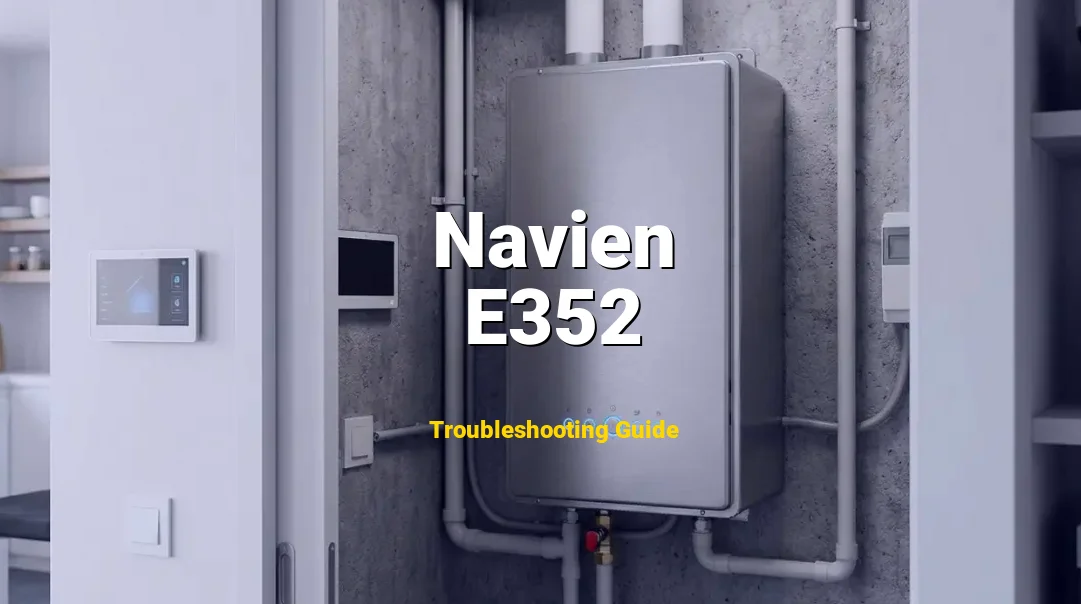
The Navien Error Code E352 indicates a **High Flow Water Leakage** detection. This safety protocol is triggered when the unit’s internal flow sensor reports continuous, high-volume water movement for an extended duration—typically exceeding 60 minutes—or detects an abnormal volumetric spike, signaling a potential internal component failure or a major external plumbing breach.
If your Navien NPE or NPN series unit displays this code, you are likely experiencing a total lockout of hot water services. You may hear the internal pump or fan cycling unsuccessfully, and the unit will cease firing to prevent heat exchanger damage. While seeing an error code can be daunting, E352 is fundamentally a protective measure. With a systematic engineering approach, we can isolate whether the fault lies within the unit’s sensors, the internal plumbing, or your home’s external piping.
Troubleshooting & Replacement Instructions
Follow these steps in sequence. Safety Warning: Before opening the unit, disconnect the electrical power supply and turn off the gas inlet valve to prevent accidental ignition or electrical shock.
⚡ Pro Tip: Verify Technical Specs
Incorrect repairs can cause fire or injury. Always verify with the manufacturer’s manual.
- Initial Power Reset and Inspection:
Start by power-cycling the unit. Unplug the power cord for a full 60 seconds to allow the PCB capacitors to discharge. Plug it back in and observe the display. If the error returns immediately without any faucets being open, the issue is likely a sensor or board fault. If it takes an hour to return, you likely have a physical leak somewhere in the home. - Internal Leak Inspection:
Use your Phillips #2 screwdriver to remove the four corner screws on the front panel. Lift the panel off and set it aside. Visually inspect all internal copper piping, the heat exchanger, and the plastic condensate trap for signs of water. Even a pinhole leak spraying onto the flow sensor wiring can cause a short circuit that triggers E352. - Isolating the Household Plumbing:
To determine if the leak is inside or outside the unit, close the cold water inlet valve (usually the blue handle under the unit). If the E352 code can be cleared and stays cleared while the water is shut off, the problem is a leak in your house’s pipes (e.g., a running toilet or broken irrigation line). If the code persists even with the water supply closed, the sensor itself is the culprit. - Testing the Flow Sensor:
Locate the flow sensor, typically found on the cold water inlet pipe inside the unit. It is a plastic housing with a three-wire harness (Red, White, and Black).
Technical Check: Disconnect the harness and use a multimeter to check for continuity. If the sensor shows a closed circuit (0 ohms) while no water is flowing, the internal Hall Effect sensor has failed. Additionally, unscrew the sensor housing to check for debris or scale. If the impeller does not spin freely with a gentle puff of air, it must be cleaned with white vinegar or replaced. - Verifying PCB Integrity:
If the sensor tests positive for functionality but the error remains, inspect the PCB for charred components or “swollen” capacitors. Ensure all wire harnesses are seated firmly. A loose connection on the “CN10” or “CN12” connectors (depending on the model) can mimic a high-flow signal due to signal noise.
Technical Explanation of the Fault
To resolve E352, we must understand the three primary failure modes that trigger this specific logic string in the Navien firmware:
1. Flow Sensor Impeller Seizure: The flow sensor utilizes a small turbine (impeller) containing a magnet. As water flows, the turbine spins, and a Hall Effect sensor on the exterior of the housing sends a pulse signal to the PCB. Over time, calcium carbonate deposits (hard water scale) or debris from the main water line can wedge into the impeller housing. If the impeller gets stuck in a “high-spin” position or if the Hall Effect sensor shorts out and sends a constant high-voltage signal, the PCB interprets this as a massive, unending flow of water (a leak).
2. Downstream Plumbing Breach: This is the “true positive” scenario. If a pipe has burst behind a wall, a toilet flapper is completely stuck open, or a slab leak has occurred, the unit is correctly identifying a high-volume flow that has exceeded the factory-set time limit (usually 60 minutes of continuous high flow). The system assumes no household “normal” use lasts that long at that volume and shuts down to prevent flooding.
3. PCB Logic Corruption or Voltage Spikes: The Printed Circuit Board (PCB) acts as the brain of the unit. If the home experiences a “brownout” or a significant power surge, the capacitors on the PCB can discharge unevenly, leading to corrupted data processing. In this state, the PCB may misinterpret a 0-GPM (gallons per minute) signal from a perfectly functional sensor as a high-flow event.
Symptoms of Navien Error E352
As a senior engineer, I categorize the symptoms of E352 into three distinct diagnostic layers. Recognizing these early can prevent secondary damage to the unit’s sensitive electronics:
- Control Panel Lockout: The most obvious sign is the LCD display flashing “E352.” When this code is active, the unit’s logic board (PCB) enters a “Hard Lockout” state, meaning it will not attempt to ignite the burner, even if there is a legitimate demand for hot water.
- Audible Component Cycling: You may hear the combustion fan or the internal circulation pump running continuously. The unit is attempting to clear residual heat or manage what it perceives as an ongoing flow of water, leading to mechanical wear if left unaddressed.
- Thermal Inconsistency: If the error is intermittent, you might notice the water fluctuating between hot and lukewarm. This often indicates the flow sensor is “fluttering”—sending erratic signals to the PCB that suggest a leak is starting and stopping.
- Physical Evidence of Moisture: In cases of true internal leakage, you may find water dripping from the bottom of the cabinet or localized corrosion on the brass fittings inside the unit.
How to Prevent Error E352
Preventing a recurrence of E352 involves maintaining both the water quality and the electrical environment of the tankless system:
- Annual Descaling (Flushing): Hard water is the primary enemy of Navien flow sensors. By performing an annual flush using a specialized descaling solution or food-grade white vinegar, you remove the calcium buildup that causes the flow sensor impeller to seize. This ensures the magnet can rotate freely and provide accurate GPM readings to the PCB.
- Installation of a High-Quality Surge Protector: Tankless water heaters are essentially computers that heat water. A dedicated surge protector prevents voltage spikes from damaging the sensitive logic gates on the PCB, which is a common cause of “phantom” E352 errors.
- Whole-Home Leak Detection: Since E352 is often a response to an actual plumbing failure, installing smart leak detectors near high-risk areas (washing machines, dishwashers) can help you identify a leak before the Navien unit reaches its 60-minute safety threshold.
Frequently Asked Questions (FAQ)
Q: Can I manually bypass Error E352 to get hot water temporarily?
A: No. E352 is a safety lockout. Bypassing safety sensors on a gas-fired appliance is extremely dangerous. If the unit believes there is a high flow and fires the burner while there is actually a blockage or a dry heat exchanger, it can lead to a catastrophic thermal event or a fire. You must resolve the root cause before the unit will resume operation.
Q: Does Error E352 mean my heat exchanger is leaking?
A: Not necessarily. While an internal leak in the heat exchanger *could* trigger this code if the volume is high enough, E352 is more commonly associated with the flow sensor’s electronic signal or a leak in the distribution piping of the home. A heat exchanger leak usually presents with an E012 (Flame Loss) or E003 (Ignition Failure) due to water dousing the burner.
Q: My unit is only two years old; why did the flow sensor fail already?
A: Flow sensor lifespan is heavily dictated by water chemistry. If you have high “grains per gallon” (hard water) and do not have a water softener or a scale inhibitor (like the Navien PeakFlow system), mineral deposits can seize the impeller very quickly, sometimes in as little as 12 to 24 months.