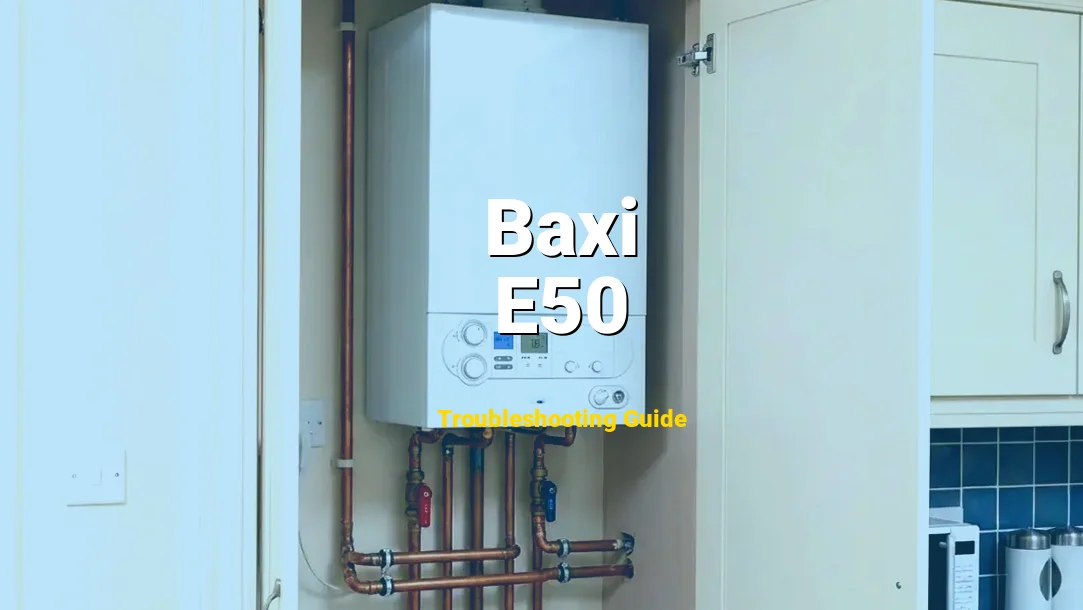
The Baxi Boiler Error E50 is a specific fault code indicating a failure in the Domestic Hot Water (DHW) sensor, also known as an NTC thermistor. This means your boiler’s brain (the PCB) can no longer accurately read the temperature of the water destined for your taps and showers.
⚡ Important: Official Documentation
Don’t guess the wiring. Get the official PDF to see the exact schematics.
Hey there, DIYer! I know seeing a blinking error code on your boiler can feel a bit overwhelming, especially when you’re standing there waiting for hot water that never arrives. You might be hearing some unusual clicking as the boiler tries to ignite, or perhaps the water is coming out frustratingly cold. But take a deep breath—you’ve got this! This is one of the more straightforward sensors to diagnose, and I’m going to walk you through every single step to get your home feeling cozy and functional again.
Quick Fix Specifications
- Difficulty: Moderate (Requires basic electrical testing and manual dexterity)
- Estimated Time: 45 to 60 minutes
- Tools Needed:
- Phillips-head screwdriver (for casing removal)
- Digital Multimeter (for testing sensor resistance)
- Adjustable wrench or specialized NTC clip tool
- Clean, dry microfiber cloth
- Estimated Cost: $15 – $45 (Replacement sensor price)
Symptoms of a Baxi E50 Fault
When your Baxi boiler suffers from an E50 error, it doesn’t just display the code; it behaves in very specific ways that can help you confirm the diagnosis. Here is what you should look out for:
- The Code: The most obvious sign is the alphanumeric “E50” flashing on the digital display panel.
- Cold or Lukewarm Water: Because the boiler cannot sense how hot the water is, it often shuts down the burner as a safety precaution, resulting in zero hot water from your taps.
- Intermittent Performance: Sometimes the sensor is just “on its way out.” You might get hot water for two minutes followed by a sudden drop to freezing temperatures.
- Lockout State: The boiler may enter a “lockout” mode where it refuses to attempt an ignition cycle until the fault is cleared or the sensor is replaced.
- Boiler Cycling: You might hear the boiler firing up and then immediately shutting down repeatedly as it struggles to interpret the erratic data from the faulty thermistor.
What Triggers this Code?
Understanding why things break is the best way to ensure they stay fixed! The E50 code is triggered when the PCB (Printed Circuit Board) detects an “Open Circuit” or a “Short Circuit” in the Domestic Hot Water sensor circuit. Here are the primary culprits:
1. Natural Wear and Tear: NTC sensors (Negative Temperature Coefficient) work by changing resistance as temperature changes. Over years of being subjected to constant heating and cooling cycles, the internal components of the thermistor can degrade, eventually failing completely. It’s essentially a consumable part that simply reaches the end of its life.
2. Corrosion and Moisture: Boilers are environments where heat and water live together. Sometimes, a tiny leak from a nearby joint or even heavy condensation can cause moisture to seep into the sensor’s electrical connector. This leads to corrosion, which interrupts the signal and forces the E50 error.
3. Voltage Spikes: While less common, a sudden surge in your home’s electrical supply can damage the sensitive electronics inside the sensor. If the sensor’s resistance profile is knocked out of its calibrated range, the PCB will flag it as a fault.
4. Loose Wiring: Vibrations from the pump or fan over several years can occasionally loosen the spade connectors or the wiring harness that connects the sensor to the main board. If the connection is loose, the “loop” is broken, triggering the fault code immediately.
How to Fix Baxi Error E50 (Step-by-Step)
Before we begin, remember: Safety first! If at any point you feel uncomfortable or smell gas, stop immediately and call a Gas Safe registered engineer. We are working on the electrical components and the external sensor, not the gas valve itself.
- Isolate the Power: This is the most important step. Locate the fused spur (the switch) for your boiler and turn it OFF. Unplug the boiler if it’s on a plug. We want zero electricity running through the unit while we work.
- Remove the Outer Casing: Using your Phillips-head screwdriver, locate the screws at the bottom of the boiler’s front panel. Carefully unscrew them and set them aside in a safe spot (like a magnetic tray). Gently lift the panel up and off the hooks, then set it aside where it won’t get scratched.
- Locate the DHW Sensor: Look for the copper pipe that leads to your hot water outlet. The DHW NTC sensor is usually a small plastic-encased component clipped onto this pipe or screwed into it. It will have two wires leading to a plug. Tip: Check your specific Baxi manual’s diagram to find the exact “Domestic Hot Water Sensor” location.
- Inspect the Connections: Pull the plastic plug off the sensor. Look for any green or white crusty buildup (corrosion). If it looks dirty, clean the contacts with a dry cloth or contact cleaner. Sometimes, simply reseating a loose plug fixes the E50 error!
- The Multimeter Test: Set your multimeter to the Ohms (Ω) setting. Touch the probes to the two terminals on the sensor. At room temperature (approx 20°C/68°F), you should see a reading of roughly 10k to 12k Ohms. If the meter shows “OL” (Open Loop) or “0.00,” the sensor is definitely dead and needs replacement.
- Replacing the Sensor:
- Clip-on type: Simply unclip the old one and snap the new one onto the pipe in the same position.
- Immersion type: You may need to drain the domestic side of the boiler first! Unscrew the old sensor with your wrench and quickly thread the new one in to minimize water loss.
- Reconnect and Reassemble: Plug the wiring harness back onto the new sensor. Ensure it clicks into place. Put the front casing back on and secure the screws.
- The Moment of Truth (Reset): Turn the power back on. Locate the “Reset” button on your Baxi control panel. Hold it for a few seconds until the E50 disappears. Turn on a hot tap and see if that beautiful warm water returns!
How to Prevent Error E50
Now that you’ve conquered the repair, let’s make sure you don’t have to do it again anytime soon. A little prevention goes a long way with modern boilers!
1. Annual Professional Service: While you can handle this sensor, a professional engineer can check the internal voltages and the health of the PCB during a yearly service. They can often spot a sensor that is starting to drift out of its resistance range before it actually fails and leaves you with a cold shower.
2. Install a Scale Reducer: If you live in a hard water area, limescale can build up around the “pocket” where the sensor sits. This acts as an insulator, forcing the sensor to work harder and stay hotter than it’s designed for. A simple inline scale reducer on your cold feed can extend the life of all your boiler’s internal components.
3. Use a Surge Protector: Since the E50 is an electrical communication fault, protecting your boiler from “dirty” power is a great idea. If your boiler isn’t already wired through a filtered circuit, consider asking an electrician about surge protection for your heating system’s power supply.
FAQ
Frequently Asked Questions
Q: Can I still use my central heating while the E50 error is active?
A: Usually, yes! Most Baxi models treat the DHW (Hot Water) and CH (Central Heating) sensors as separate circuits. While you won’t have hot water for your shower, your radiators should still function. However, the boiler may eventually lock out entirely if the fault isn’t cleared, so it’s best to fix it quickly.
Q: Is the E50 error dangerous? Can the boiler explode?
A: Not at all. The E50 error is a “fail-safe” measure. The boiler detects that it can’t monitor the temperature, so it shuts down the burner to *prevent* overheating or dangerous water temperatures. It is an inconvenience, not a danger.
Q: Why does the error go away when I reset it, but then come back 10 minutes later?
A: This is a classic sign of a “failing” sensor rather than a “failed” one. As the sensor heats up, the internal hairline fractures in the thermistor expand, breaking the electrical circuit. When it cools down, the connection is restored. This “intermittent” behavior confirms that the sensor needs to be replaced immediately.